Miner Boxes
Miner heat reuse: how to heat your home with an ASIC
Every ASIC miner is also an electric heater. Practically every watt it draws from the wall comes back out as warm air. An Antminer S21 drawing 3.5 kW gives off 3.5 kW of heat, all day, every day. Most home miners treat that heat as a problem. This guide is about treating it as a resource: how much a miner can really warm, how to move the heat where you want it, and what to do with it in summer.
How much heat does a miner give off?
The rule is simple: heat out equals power in. A miner does no mechanical work and stores no energy, so the electricity it consumes ends up as heat in the room. The hashes are a by-product, as far as physics is concerned.
To turn that into floor area, we use 70 W per m², a typical heating need for an insulated home in a Central-European winter. Older or poorly insulated buildings need more; a new low-energy house needs much less.
| Miner | Heat output | Heat per day | Warms about |
|---|---|---|---|
| Antminer T21 | 3.6 kW | 87 kWh | 50 m² |
| Antminer S21 | 3.5 kW | 84 kWh | 50 m² |
| iBeLink BM-KS Max | 3.4 kW | 82 kWh | 50 m² |
| IceRiver KS3M | 3.4 kW | 82 kWh | 50 m² |
| Antminer KS5 Pro | 3.15 kW | 76 kWh | 45 m² |
| IceRiver KS2 | 1.2 kW | 29 kWh | 15 m² |
In other words, one modern Bitcoin miner produces about as much heat as a two-room flat needs on a cold day. That's a lot of heat to waste.
Step 1: get the heat out in one place
A bare miner blows hot air out of its back at high speed and spreads it, along with the noise, around the room. Before you can reuse the heat, you need it leaving from a single, predictable outlet.
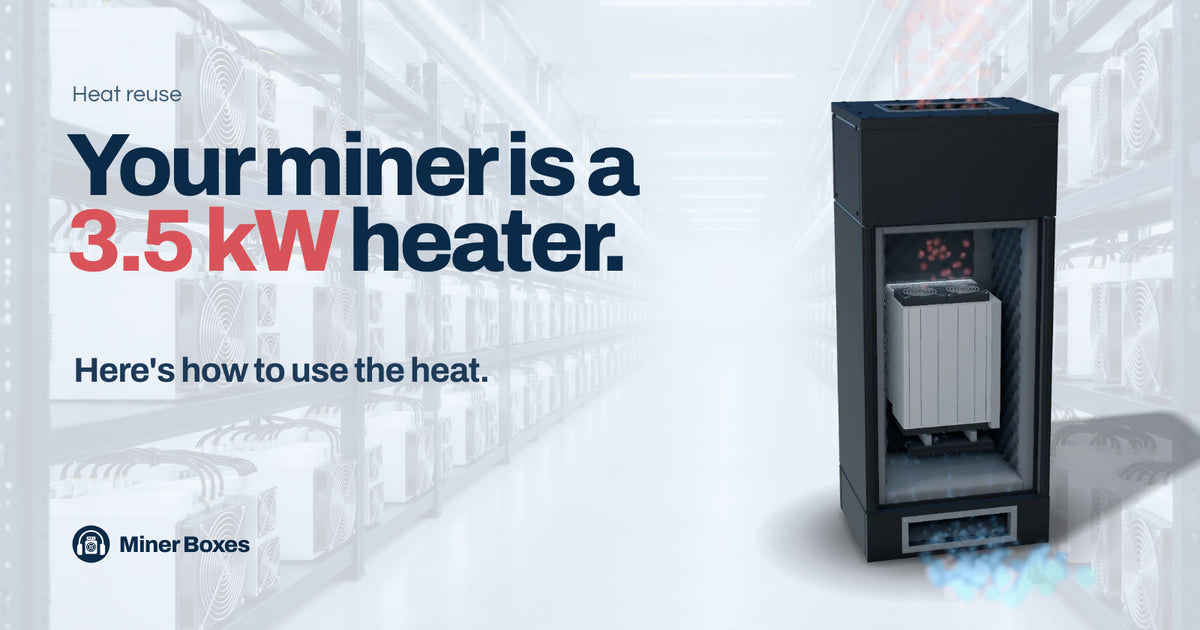
That is one of the jobs a Miner Box does. Inside, the air path is split in two: cool room air enters through the grille at the bottom front and feeds the miner's fans directly, while the hot side faces up, so warm air rises out of the top on its own. On the large box it leaves through the opening in the lid; on the small box through the vent in the front of the top section. Either way you get one warm, steady air stream, and that is something you can attach a duct to.
Step 2: duct it where you need it
With a duct on the exhaust, the heat goes where you send it. The most common setups we see:
- Into a cold room. A bedroom above a garage, a workshop, a home office on the north side. Run the duct through a wall or the ceiling and the room gets a steady, silent supply of warm air.
- Into the hallway or stairwell. Warm air rises, so a miner on the ground floor ducted into the stairwell heats the floors above it.
- Into the room it stands in. The simplest option: no duct at all. In a sealed Miner Box at about 35 dB, the miner can stand beside your desk and heat your office directly.
- Into a greenhouse, garage or workshop. Spaces that only need to stay above a certain temperature are an ideal match for a constant heat source.
-
Straight Into your AC lines. Most elegant solution
- Floor heating. Ideal for larger rooms. Bathroom, hallways, living spaces, kitchen.
A few rules make the difference between a duct that works and one that makes the miner run hot:
- Keep it short and wide. Every metre and every bend adds resistance. If the duct is too long, too narrow or too bent, hot air backs up, the miner's fans spin up to push it through, and the noise and temperature both rise. Use the full outlet size and as few bends as you can.
- Use metal duct. Miner exhaust is hot. Use aluminium or galvanised steel duct rated for warm air, not thin plastic, and fix every joint.
- Insulate long runs. A duct that runs through an unheated loft or garage loses its heat along the way. Insulated duct keeps it for the room it's meant for.
- Give the room an air path back. Air you push into a room has to leave it somewhere. A door gap or a transfer grille is enough; without one, the duct pushes against pressure.
- Never draw the warm air back in. The miner must always breathe cool air. If the duct ends in the same small room the miner stands in, that room can heat up until the miner throttles. Read our guide to miner overheating for the warning signs.
We make a duct adapter for the Miner Box exhaust. Ask us about it and tell us where you want the heat to go.
Step 3: plan for summer
The same heat that is free heating in January is unwanted in July. Plan for it on day one:
- Vent outside. The simplest summer setup is a second duct route, or a removable section, that sends the exhaust through a window panel or a wall vent to the outside.
- Use a switchable damper. With a two-way damper you choose with one lever: heat into the house in winter, outside in summer.
- Watch the intake temperature. In a hot summer room, the problem isn't the exhaust, it's the air the miner breathes. If the room itself passes about 35 °C, the miner works harder to stay cool. A cooler room (a basement, a north-facing room) helps more than anything else.
- Consider running fewer hours. Some home miners reduce power or pause during the hottest weeks. Many miners support lower-power modes in their firmware settings.
Is heating with a miner worth it?
An honest comparison:
- Against an electric heater: a miner wins clearly. Both turn one kWh of electricity into one kWh of heat. The heater gives you only heat; the miner gives you the same heat and mining rewards on top. If you heat with direct electric heaters today, every kWh the miner uses in the heating season is a kWh you would have paid for anyway.
- Against a heat pump: a heat pump wins on heat alone. A good heat pump delivers 3 to 4 kWh of heat for every kWh of electricity. A miner delivers one. Where a miner still makes sense alongside a heat pump is in rooms the heat pump doesn't reach well, or when the mining rewards cover the electricity.
- Against gas: it depends on your local gas and electricity prices. Compare the price of one kWh of each, then subtract what the miner earns per kWh.
The calculation is always your electricity price against what the miner earns, minus what you would have spent on heat anyway. In the heating season, that last part can change the answer completely.
Checklist
- Know your miner's power: that's its heat output.
- Get the heat out from one outlet (a box with a top exhaust does this).
- Short, wide, metal duct, insulated where it passes cold spaces.
- The miner always breathes cool air; warm air never loops back.
- A summer route outside, ideally on a damper.
- Check the numbers: your electricity price, your current heating cost, the miner's earnings.
Want to see how much floor your miner can heat? Pick it in the heat chart on our homepage, or find the box for your miner.