

Every few months, someone declares that home Bitcoin mining is dead.
I’ve seen the headlines for years.
“Mining is only for corporations now.”
“Industrial farms have won.”
“Small miners can’t compete anymore.”
And yet, despite all those predictions, thousands of people around the world are still running mining equipment from their homes, garages, workshops, and spare rooms.
The truth is more nuanced.
Home mining isn’t dead.
It’s evolving.
In fact, from my experience working in the crypto mining industry for more than five years, the biggest challenge facing home miners in 2026 isn’t necessarily electricity costs, Bitcoin difficulty, or hardware efficiency.
It’s noise.
Modern Crypto Mining Hardware is incredibly powerful, but that power comes with a side effect that many new miners underestimate: sound.
The good news?
Noise is one of the few mining challenges that can actually be solved.
And once you solve it, home mining suddenly becomes much more practical than most people realize.
Let’s explore why.
Why People Think Home Mining Is Dead
The perception isn’t completely unreasonable.
Bitcoin mining has become significantly more competitive over the past decade.
Large mining companies now operate facilities containing thousands of ASIC miners.
These industrial-scale operations benefit from:
- Bulk hardware purchasing
- Professional cooling systems
- Lower electricity rates
- Dedicated technical staff
- Enterprise infrastructure
Compared to those massive operations, a single miner running in a garage may seem insignificant.
However, that’s the wrong comparison.
Most home miners aren’t trying to compete with industrial farms.
They’re pursuing different goals:
- Building Bitcoin exposure
- Learning mining technology
- Generating passive income
- Supporting network decentralization
- Accumulating Bitcoin over time
For these miners, profitability isn’t always measured the same way.
The question isn’t:
“Can I outperform a 500 MW mining facility?”
The question is:
“Can I operate efficiently and sustainably from home?”
And surprisingly often, the answer is yes.
The Real Problem: Crypto Mining Hardware Is Loud
Here’s what many first-time miners discover after powering up their equipment.
ASIC miners are not designed for living rooms.
They’re designed for data centers.
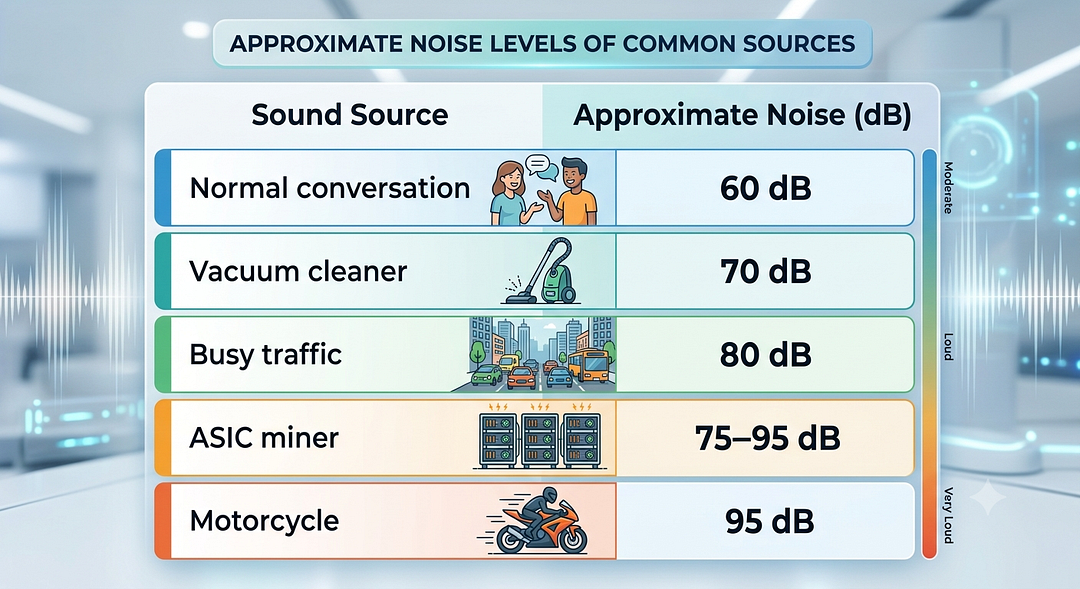
Most modern Crypto Mining Hardware generates between:
- 75 dB
- 85 dB
- 95 dB
depending on the model and operating conditions.
To put that into perspective:
That’s why so many home miners eventually run into challenges with:
- Family members
- Neighbors
- Sleep disruption
- Home office productivity
- General comfort
Ironically, many people quit home mining not because it isn’t profitable — but because they can’t live with the noise.
The Evolution of Home Mining in 2026
The home mining landscape has changed dramatically.
A few years ago, miners focused almost exclusively on:
- Hashrate
- Electricity cost
- ROI calculations
Today, miners are thinking more holistically.
They’re asking:
- Can I operate quietly?
- Can I manage heat efficiently?
- Can I integrate mining into everyday life?
- Can I run equipment long-term without disrupting my household?
This shift is transforming how people approach Crypto Mining Hardware.
The most successful home miners aren’t necessarily running the largest setups.
They’re running the smartest ones.
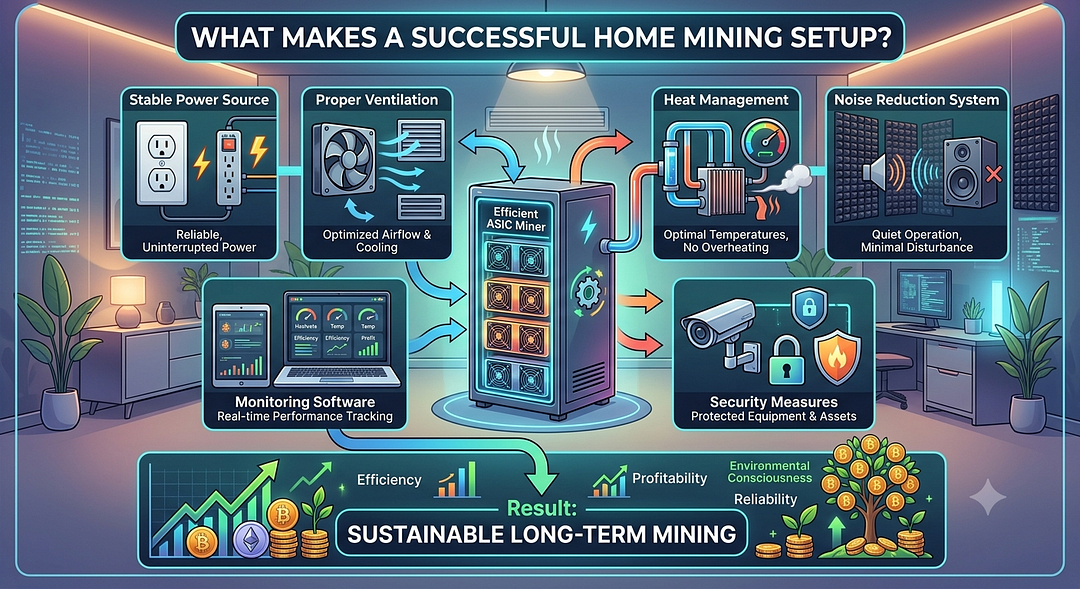
Visual Guide: The Modern Home Mining Environment
Why Noise Matters More Than Most People Realize
Noise isn’t just annoying.
It affects the entire mining experience.
From my own experience, constant exposure to loud mining equipment can lead to:
Reduced Productivity
Working near loud miners becomes exhausting over time.
Even when you think you’re ignoring the sound, your brain continues processing it.
Increased Stress
Continuous industrial noise creates background stress that accumulates throughout the day.
Family Frustration
Many miners discover that their biggest challenge isn’t technology.
It’s convincing everyone else in the house to tolerate the setup.
Limited Scaling
Without addressing noise, adding more equipment becomes nearly impossible.
One miner may be manageable.
Three or four quickly become overwhelming.
The Hidden Relationship Between Heat and Noise
An important concept many beginners miss is that noise and temperature are closely connected.
When temperatures increase:
- Fans spin faster
- Airflow turbulence increases
- Noise levels rise
This creates a cycle:
Higher Heat → Faster Fans → More Noise
That’s why simply adding insulation often fails.
You can’t just trap sound.
You need to manage airflow intelligently.
The best solutions reduce noise while maintaining proper cooling.
How MinerBoxes Changed the Home Mining Equation
This is where specialized mining enclosures enter the picture.
Instead of treating noise as an unavoidable side effect, systems like MinerBoxes are designed specifically to address the acoustic challenges of Crypto Mining Hardware.
What impressed me most about enclosure-based solutions is that they focus on balance.
The goal isn’t to completely eliminate sound.
The goal is to:
- Reduce acoustic output
- Maintain airflow
- Protect hardware
- Improve overall usability
That balance is critical.
Many DIY solutions reduce noise temporarily but create heat problems.
Professional enclosure systems are engineered to address both simultaneously.
Learn more here: https://minerboxes.com/
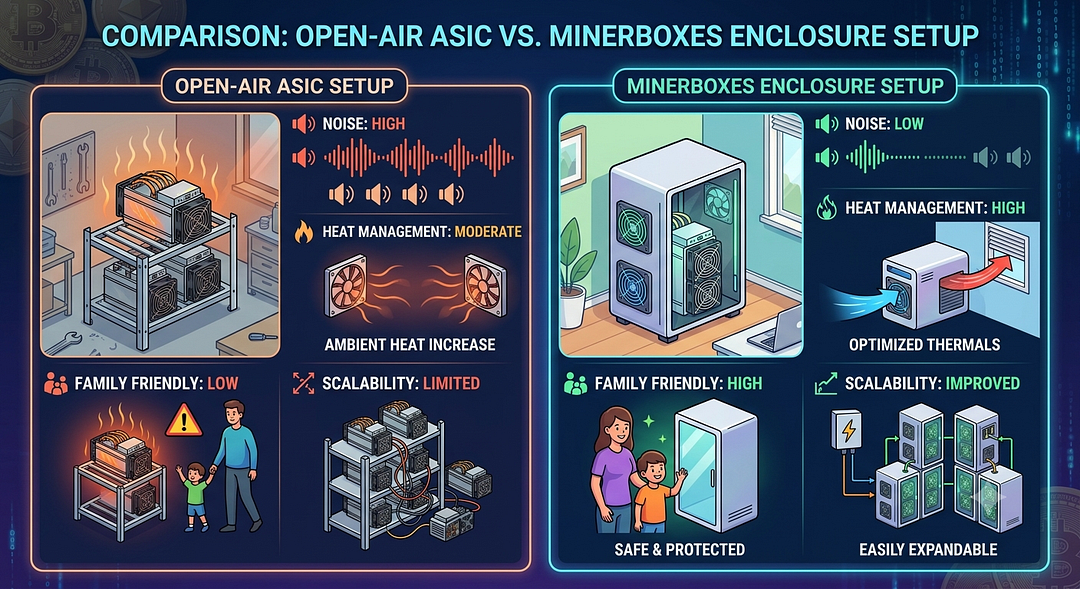
Visual Comparison: Open-Air Mining vs Enclosed Mining
The Rise of the Quiet Home Mining Movement
One trend I’ve noticed throughout 2025 and 2026 is the emergence of what I call “quiet mining.”
Instead of treating mining as a purely industrial activity, miners are designing environments that fit naturally into residential settings.
Examples include:
- Garage installations
- Utility room setups
- Workshop mining stations
- Dedicated mining closets
- Basement operations
These setups prioritize:
- Comfort
- Organization
- Safety
- Noise reduction
- Long-term sustainability
As a result, home mining is becoming more accessible than many people realize.
Common Myths About Home Bitcoin Mining
Myth #1: Home Mining Is Always Unprofitable
Not true.
Profitability depends on:
- Hardware efficiency
- Electricity costs
- Bitcoin price
- Operational strategy
Every situation is different.
Myth #2: You Need a Warehouse
Many successful miners operate one or two machines effectively from home.
Scale is not always the goal.
Consistency often matters more.
Myth #3: Noise Can’t Be Fixed
This may have been partially true years ago.
Today, there are far more solutions available.
From improved ventilation to specialized enclosures, miners have significantly more options than before.
The Future of Crypto Mining Hardware
Looking ahead, I believe the next generation of Crypto Mining Hardware will focus on more than just efficiency.
Manufacturers and miners alike are becoming increasingly aware of:
- Acoustic performance
- Thermal management
- User experience
- Home integration
As Bitcoin adoption grows, more people will want exposure to mining without industrial-level disruptions.
That creates demand for smarter infrastructure.
Not just more powerful hardware.
Better environments.
My Advice to New Home Miners in 2026
If you’re considering home mining this year, here’s what I’d recommend.
Don’t focus exclusively on profitability calculators.
Think about your entire environment.
Ask yourself:
- Where will the miner operate?
- How will you manage airflow?
- How will you handle heat?
- How will you reduce noise?
The answers to those questions often determine success more than hash rate alone.
Because the most profitable miner is the one you can comfortably operate for years — not weeks.
Final Thoughts: Home Mining Isn’t Dead It’s Growing Up
The narrative that home Bitcoin mining is dead misses the bigger picture.
Home mining isn’t disappearing.
It’s maturing.
Today’s miners are becoming smarter about:
- Environment design
- Noise management
- Heat control
- Long-term sustainability
And that’s a good thing.
The future of Crypto Mining Hardware isn’t simply about bigger machines or larger facilities.
It’s about making mining practical, efficient, and livable for everyday people.
For many miners, the obstacle isn’t profitability.
It’s noise.
Solve the noise problem, and suddenly home mining becomes far more realistic than the headlines would have you believe.
In 2026, the question isn’t whether home mining is dead.
The question is whether you’re willing to build a setup that works with your life instead of against it.
And increasingly, that’s exactly what modern home miners are doing. 🚀🔇
🔗 Stay Connected
🎥 YouTube
📱 TikTok